
CISSP Certification Guide
A complete step-by-step guide to CISSP certification, exam structure, study strategy, and career impact

Introduction
The CISSP (Certified Information Systems Security Professional) is one of the most recognized cybersecurity certifications for experienced professionals who design, lead, implement, or oversee security programs. It is awarded by ISC2 and is aimed at people who can think beyond single technologies and make sound security decisions in a business context.
This guide covers what CISSP is, who it is for, the exam format, eligibility, how to prepare, what happens after you pass, and how to maintain the certification. It is written to help candidates make good decisions before they spend time and money on the journey.
What Is the CISSP Certification?
CISSP is an advanced cybersecurity certification focused on security leadership, governance, architecture, risk, operations, and secure design. ISC2 positions it as a certification for professionals who can effectively design, implement, and manage a strong cybersecurity program.
It is widely valued by employers because it signals breadth across security domains, not just depth in one technical specialty. In many organizations, CISSP is associated with senior analyst, architect, engineer, consultant, manager, and leadership-track roles.
Why CISSP Is So Valuable
In many countries, the CISSP certification is regarded as one of the most prestigious credentials in information security. It is seen as a professional standard for senior roles in large organizations and, in some industries, is even a prerequisite.
- Europe: The certification is equivalent to Level 7 within the European Qualifications Framework (EQF), placing it at the level of a master’s degree.
- United States: Recognized as the “gold standard” in information security management and officially acknowledged by the U.S. Department of Defense under U.S. DoDM 8140.03 and by ANAB.
Who Should Pursue CISSP?
CISSP is a strong fit for professionals such as:
- Security managers
- Security architects
- Security consultants
- Senior security analysts
- GRC and risk professionals
- IT and cybersecurity leaders
- Engineers moving into broader design or leadership roles
CISSP is usually not the best first certification for beginners. ISC2 requires substantial paid work experience for the full certification, and the exam expects judgment across multiple domains rather than narrow technical memorization. Candidates earlier in their career may be better served by starting with a foundational certification and then returning to CISSP later.
Is CISSP Worth It?
For experienced professionals, usually yes.
CISSP is worth it when you want to:
- Move into broader security responsibility
- Validate leadership-level cybersecurity knowledge
- Increase credibility with employers or clients
- Qualify for roles that explicitly ask for CISSP
CISSP can help you:
- Demonstrate broad, senior-level cybersecurity knowledge
- Qualify for roles that explicitly list CISSP as preferred or required
- Strengthen credibility with employers, clients, and peers
- Move from purely technical execution into architecture, governance, consulting, or leadership work
It is especially valuable for people who need to connect security to risk, compliance, business operations, and executive decision-making.
CISSP Exam Overview
According to ISC2, the CISSP exam uses a Computer Adaptive Testing format and has these key parameters:
- 100 to 150 questions
- 3 hours
- Passing score of 700 out of 1000
- English CAT (Computer Adaptive Testing) format for the current outline and delivery model described by ISC2
The exam is designed to measure both knowledge and judgment. It does not simply test whether you remember definitions. It tests whether you can choose the best answer in a realistic security context.
The Eight CISSP Domains
The CISSP exam is built around eight domains in the ISC2 Common Body of Knowledge.
1. Security and Risk Management
This domain covers governance, risk management, legal and regulatory considerations, compliance, ethics, security policy, and organizational security strategy.
Key themes include: – risk assessment and treatment – governance and accountability – security policies and standards – compliance and professional ethics
2. Asset Security
This domain focuses on identifying, classifying, handling, retaining, and protecting information and other assets throughout their lifecycle.
Key themes include: – data classification – data ownership and handling – retention and destruction – privacy and protection requirements
3. Security Architecture and Engineering
This domain covers secure design principles, security models, system architecture, cryptography, vulnerabilities, and physical security considerations.
Key themes include: – secure design and engineering – cryptographic concepts and usage – hardware and platform security – evaluation models and control selection
4. Communication and Network Security
This domain focuses on network architecture, secure communication channels, transmission methods, and protecting networked systems.
Key themes include: – secure network design – segmentation and boundary protection – secure protocols – network attack mitigation
5. Identity and Access Management (IAM)
This domain covers identities, authentication, authorization, access provisioning, and accountability.
Key themes include: – identity lifecycle – access control models – federation and SSO – MFA and privileged access
6. Security Assessment and Testing
This domain addresses how organizations validate that controls are working as intended.
Key themes include: – testing strategies – vulnerability assessment – audits and reviews – collecting and interpreting security test results
7. Security Operations
This domain focuses on the operational side of security: monitoring, incident response, logging, investigations, resilience, backup, disaster recovery, and business continuity.
Key themes include: – incident handling – logging and monitoring – operational resilience – recovery processes
8. Software Development Security
This domain covers how security should be integrated into software development and maintenance processes.
Key themes include: – secure SDLC – common software weaknesses – development environment controls – software security testing

CISSP Eligibility Requirements
Passing the exam alone does not automatically make someone a CISSP. To earn the certification, ISC2 requires five years of cumulative, full-time paid work experience in two or more of the eight CISSP domains. A relevant degree or an approved credential can waive up to one year of the experience requirement.
This distinction is important:
- You can sit for the exam before you have the full required experience.
- If you pass the exam without enough experience, you can become an Associate of ISC2 while you gain the remaining experience.
That means the journey has two separate milestones:
- pass the exam
- satisfy the experience and endorsement requirements for the full certification
How to Register for the CISSP Exam
Registration is handled through ISC2 and its test delivery process. Candidates should verify the latest scheduling options, pricing, and test-center details directly with ISC2 before booking. The exam is generally presented through in-person delivery, and candidates should always confirm current policies at the time of registration.
You can access the registration form here.
How to Prepare for CISSP
A good CISSP study plan is structured, realistic, and based on your starting point.
Recommended Study Approach
A practical plan for many candidates is:
- 8 to 12 weeks of focused preparation
- 5 to 3 hours per day on most days
- heavier review on weaker domains
- regular mixed practice questions
- repeated review of wrong answers and weak concepts
People with stronger experience in several CISSP domains may need less time. People coming from narrow technical roles often need more time, especially for governance, legal, risk, and policy topics.
A Simple 10-Week CISSP Plan
Weeks 1–2
Build your foundation. Review the exam structure, assess your weak domains, and cover Security and Risk Management plus Asset Security.
Weeks 3–5
Study Security Architecture and Engineering, Communication and Network Security, and IAM. Focus on principles, not just definitions.
Weeks 6–7
Study Security Assessment and Testing, Security Operations, and Software Development Security.
Weeks 8–9
Shift into mixed question practice. Review every wrong answer carefully. Identify patterns in your mistakes.
Week 10
Do final revision, short notes, flashcards, concept review, and exam-readiness work. Avoid panic cramming.
Best CISSP Study Strategy
The most effective candidates usually do four things well:
Learn concepts, not isolated facts
CISSP is not a pure memorization exam. You need to understand why a control is used, when it is appropriate, and what business problem it solves.
Practice question analysis
Practice questions are useful not only for knowledge but also for learning how exam writers frame risk, prioritization, and “best answer” logic.
Study weak domains early
Do not leave your weakest domains until the end. Attack them early while you still have time to revisit them.
Think across domains
Many questions require you to connect multiple areas. A scenario may involve architecture, legal obligations, IAM, and operations at the same time.
CISSP Exam Mindset and Tips
One of the most important parts of CISSP is the decision-making mindset.
One of the most crucial aspects of the exam is how you approach each question. It is not just about reading comprehension (although that is important) but also about prioritization, perspective, understanding the ultimate goal, and avoiding distractors designed to mislead you.
Below are the key principles for approaching the exam:
- Think “big” – The exam is designed for big and international organizations. There is no room for cutting corners, a “things will work out” mindset, or reasoning such as “our company is too small for this.”
- Human life comes first – A golden rule is that human life takes priority over everything else. This principle is often hidden within the questions, so look for the answer that seems correct but endangers human life-and eliminate it.
- The business comes before security – Never forget that a business must function. Security cannot reach a point where it prevents the business from operating. Keep this in mind.
- Beware of vendor-based solutions – One downside of having hands-on experience is that much of your knowledge comes from security vendors. In the exam, you must focus on security functions rather than marketing terms.
- Look for the required outcome – You may see multiple correct answers, but always search for the one that provides the desired final result rather than just part of the solution.
- Think like a manager or consultant – You must look at the presented problem or question from a strategic, high-level perspective.
- Avoid getting lost in technical details – A manager does not solve technical problems! While this might be common practice in certain workplaces, it is not how the exam is structured.
- Address the root cause, not just the symptoms – As a manager, your proposed solution should not merely treat a symptom but rather tackle the fundamental problem (root cause).
- Information security is not just technical – Don’t jump to technical solutions immediately! Physical security and administrative policies are equally important.
This is where many candidates gain or lose points.
CISSP Study Resources
ISC2 provides official exam outlines and self-study resources, which should always be part of your preparation because they define the tested scope.
A balanced resource stack often includes: – one primary study guide – one question bank – one concise review source – flashcards or notes for repetition – official ISC2 outline for scope control
When choosing third-party resources, prioritize materials that explain why an answer is best, not just what the answer is.
Books
Official ISC2 CISSP Study Guide (Sybex) – The official ISC2 book covering all domains with detailed explanations, practice questions, and topic summaries.
CISSP All-in-One Exam Guide (Shon Harris) – A highly regarded, comprehensive guide with in-depth explanations and practical examples for every exam topic.
CISSP Exam Cram (Michael Gregg) – A concise, focused book designed for last-minute review, emphasizing key concepts and practice questions.
Courses
Cybrary (Kelly Handerhan) – A popular video course featuring clear explanations, real-world examples, and insights into the exam mindset.
Study Notes and Theory (Luke Ahmed) – A comprehensive learning platform with detailed summaries, practice questions, and discussions on exam question analysis.
Udemy (Thor Pedersen) – One of Udemy’s most-watched courses, including detailed explanations, mock exams, and structured video lessons.
Destination Certification (Rob Witcher) – A complete course with supplementary study materials (such as an app) and practice questions.
ISC2 CISSP Online Bootcamp – Intensive live virtual learning from an ISC2 Authorized Instructor.
ISC2 CISSP Online Self-Paced – Official ISC2 Online Self-Paced CISSP Training.
Practice Questions
Boson Practice Exams – An advanced practice question database with an intuitive interface, offering detailed explanations for both correct and incorrect answers.
ISC2 CISSP Study Tools and Resources – Self Study Tools from ISC2.
Here are some of our example key questions:
Q: How much security is “too much security”?
- When the cost of security exceeds the value of the protected assets
- There is no such thing as “too much security”
- When security controls are so strict that IT staff is starting to complain about required maintenance time
- When security controls are stricter than required by your regulator
Correct answer and Explanation
Correct Answer: 1
Explanation: Trick Question for the Experienced Student. There is such a thing as “too much security,” and it’s important to know when this happens.
Q: Which of the following best describes the difference between due care and due diligence?
- Due care involves orchestrating and reconstructing methodologies, procedures, conventions, and controls while due diligence involves conducting periodic scrutiny, evaluations, corroboration, and updates to ensure that the due care measures are adequate
- Due diligence involves implementing and maintaining appropriate policies, procedures, standards, and controls while due care involves conducting regular audits, assessments, tests, and updates to ensure that the due care measures are adequate
- Due diligence involves orchestrating and reconstructing methodologies, procedures, conventions, and controls while due care involves conducting periodic scrutiny, evaluations, corroboration, and updates to ensure that the due care measures are adequate
- Due care involves implementing and maintaining appropriate policies, procedures, standards, and controls while due diligence involves conducting regular audits, assessments, tests, and updates to ensure that the due care measures are adequate
Correct answer and Explanation
Correct Answer: 4
Explanation: English Reading Comprehension and Vocabulary Question. Due Care focuses more on daily details at the individual level, while Due Diligence focuses on a broader view like procedures, etc.
Q: In the RSA algorithm, what is the maximum block size for a 2048-bits key size?
- 2059-bits
- 2048-bits
- 2037-bits
- 1024-bits
Correct answer and Explanation
Correct Answer: 3
Explanation: Knowledge Only Question. There is no way to infer the correct answer from the possible options except by remembering the small details that sometimes seem unimportant exam prep might still show up on the exam
What to Expect on Exam Day
Arrive early and be ready for strict test-center procedures. Bring the required identification and review the test-center rules in advance.
During the exam: – read carefully – do not rush – do not obsess over previous questions – stay calm if the test feels difficult – remember that CAT exams adapt and you cannot assume your result from the question sequence alone
Your exam may end at 100 questions or continue beyond that, depending on the adaptive process. What matters is the quality of your decisions, not trying to “game” the exam while you are taking it.
What Happens After You Pass?
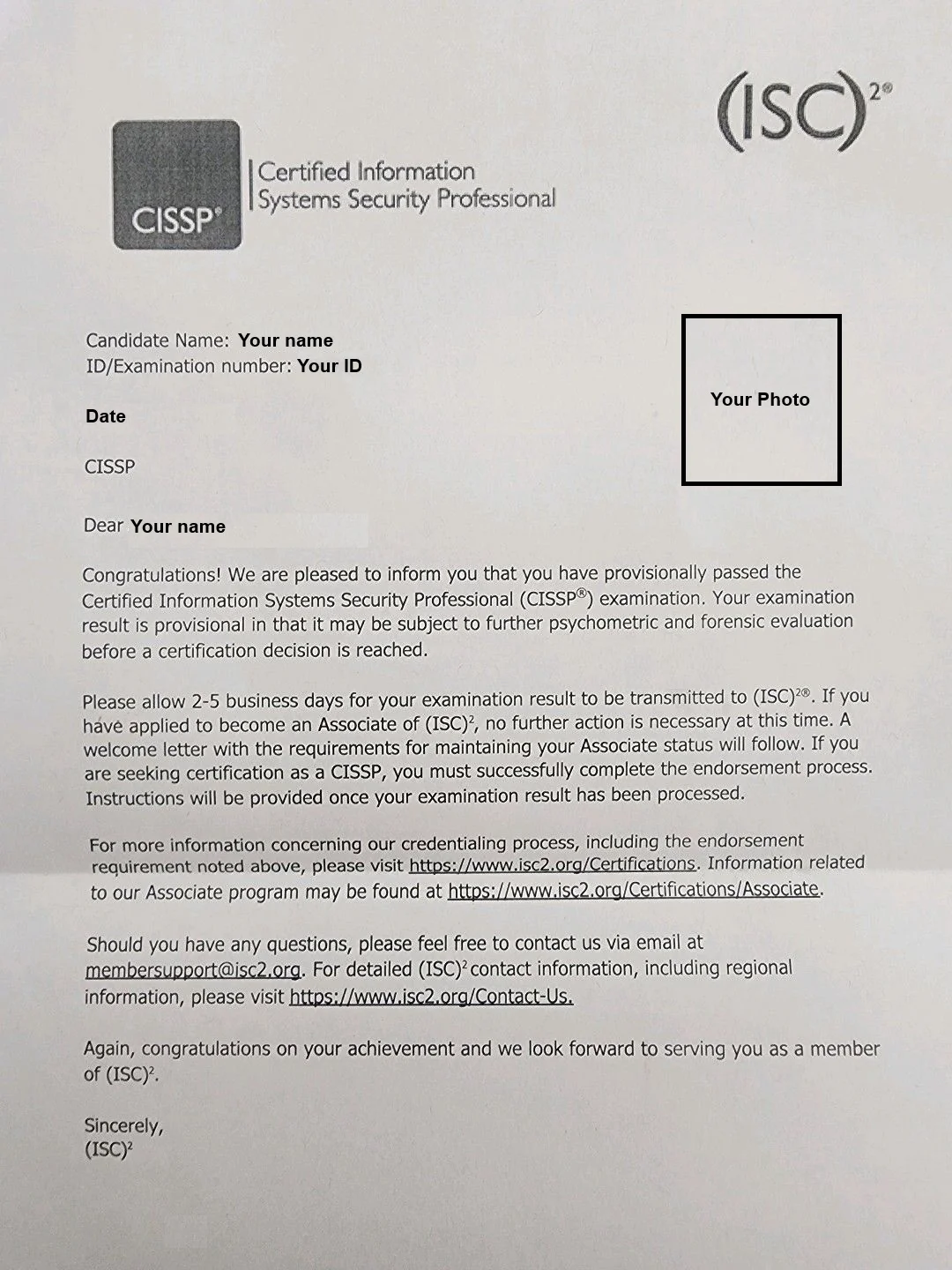
After passing the exam, you still need to complete the certification process.
That typically includes: – proving the required work experience – completing the endorsement application – agreeing to the ISC2 Code of Ethics
Candidates who pass the exam must complete the endorsement step within the timeframe required by ISC2. Some guides highlight the importance of completing this within 9 months, so candidates should verify the current deadline directly with ISC2 at the time they pass.
If you do not yet have enough experience, you can hold Associate of ISC2 status while you complete the requirement.
What If You Do Not Pass?
Not passing CISSP does not mean you are far away. Often it means one of three things:
- your breadth was not yet strong enough
- your question analysis was not strong enough
- your study plan overemphasized memorization instead of judgment
Use the result as feedback. Rebuild your plan around weak domains and decision-making practice, then retake according to ISC2 retake policy.
Maintaining Your CISSP Certification
To maintain CISSP, members must meet ISC2 continuing education and maintenance requirements. ISC2 requires ongoing professional education activity and annual maintenance fees. The AMF page states that members and Associates must pay annual maintenance fees, and ISC2’s current CISSP AMF is listed at US$135 per year.
You should also expect to maintain your certification by earning and reporting Continuing Professional Education credits according to ISC2 membership rules and timelines. Always verify the current policy in your ISC2 dashboard or official member resources, because operational details can change.
CISSP FAQ
What is the CISSP Certification?
The CISSP (Certified Information Systems Security Professional) is a premier certification in information security recognized worldwide as a rigorous standard for senior security professionals.
Who awards the CISSP Certification?
Why is the CISSP Certification so prestigious?
CISSP is considered the “gold standard” in many regions, including recognition by the U.S. Department of Defense, ANAS (ANSI) and equivalence to a master’s degree in Europe (EQF Level 7).
It is often a prerequisite or highly desired for senior cyber security roles in large organizations and is highly regarded across multiple industries.
Who is the CISSP Certification designed for?
Primarily, CISSP targets managers and professionals leading strategic processes in organizations. Although the certification includes significant technical content, it’s ideal for those looking to blend technical expertise with strategic business insight.
What topics does the CISSP exam cover?
The CISSP exam is structured around eight domains known as the Common Body of Knowledge (CBK), which encompass the key areas of information security.
How is the CISSP exam structured?
- Questions: 100 to 150 questions (mostly multiple choice with some different formats)
- Duration: 3 hours
- Adaptive Testing: It uses Computer Adaptive Testing (CAT), meaning the difficulty and number of questions adjust in real time based on your performance.
What is the passing score for the CISSP exam?
A minimum score of 700 out of 1000 is required to pass.
What are the prerequisites to earn the CISSP certification?
What if I don’t meet the prerequisites to earn the CISSP certification?
If you pass the exam without meeting the experience requirement you receive an “Associate of ISC2” status until you gain the necessary experience.
How do I register for the CISSP exam?
Registration involves filling out an application form and paying the exam fee. Note that the exam is conducted in in test centers (Such as Pearson VUE testing center) not online.
How should I prepare for the CISSP exam?
- Study Plan: Dedicate about 3 hours per day over 3 months.
- Practice Questions: Aim for at least 2,000 practice questions (4,000–5,000 for optimal preparation).
- Concept Integration: Focus on understanding how concepts interconnect across the different domains.
What happens after I pass the CISSP exam?
If you have the required experience, you must have an active CISSP professional endorse your work history and submit the necessary forms with information regarding you professional and personal background.
If you don’t have the required experience, you may apply for “Associate of ISC2” status.
What if I don’t pass the CISSP exam?
How do I maintain my CISSP certification?
- Annual Maintenance Fee (AMF): Paid yearly.
- Continuing Professional Education (CPE): You must submit a report every three years documenting activities that contribute to your professional development (credits can be earned through webinars, trainings, reading or writing related materials, attending events, or volunteering with ISC2)
How much is the ISC2 Annual Maintenance Fee (AMF)?
The Annual Maintenance Fee (AMF) for ISC2 certifications varies depending on the specific certification you hold. For the Certified Information Systems Security Professional (CISSP) certification, the AMF is U.S. $135 per year. This fee supports the costs associated with maintaining ISC2 certifications and related support systems.
Fee might change from time to time so it’s advisable to check the latest pricing on the official ISC2 website or contact ISC2 directly for the most current information
What happens if I don’t pay the Annual Maintenance Fee (AMF) on time?
If you do not pay your AMF on time, ISC2 provides a 90-day grace period from your due date to pay the fee in full. Failure to pay within this grace period will result in the termination of your certification status.
Please note that policies and fees are subject to change, so it’s important to consult the official ISC2 website or contact ISC2 directly for the most current information.
What happens if I don’t submit the Continuing Professional Education (CPE) on time?
Failing to submit the required Continuing Professional Education (CPE) credits within your certification cycle can lead to the suspension or termination of your certification. It’s essential to meet both the CPE and AMF requirements to maintain your certification in good standing.
Please note that policies and fees are subject to change, so it’s important to consult the official ISC2 website or contact ISC2 directly for the most current information.
How often should I submit my Continuing Professional Education (CPE)?
For the CISSP certification, you are required to earn and submit a total of 120 CPE credits over a three-year certification cycle, averaging 40 credits per year. It’s recommended to submit CPE activities as you complete them to ensure timely compliance.
Please note that policies and fees are subject to change, so it’s important to consult the official ISC2 website or contact ISC2 directly for the most current information.
How do I earn Continuing Professional Education (CPE)?
You can earn CPE credits through various professional development activities, including attending webinars and conferences, completing online self-paced training, participating in online boot camps and more.
How much does the CISSP exam cost?
Where can I find learning CISSP materials?
Why do people call the CISSP exam “a mile long but an inch deep”?
The CISSP exam is often described as “a mile long but an inch deep” because it covers a broad range of topics across multiple domains in information security but does not delve deeply into each area.
This means that while the exam tests a wide spectrum of knowledge, the questions typically assess foundational understanding rather than in-depth technical expertise in each domain.
How many attempts do I have to pass the CISSP exam?
There is no limit to the number of times you can attempt the exam. However, ISC2 allows candidates to retake the CISSP exam under the following conditions:
- After the first unsuccessful attempt, you can retake the exam after 30 days.
- After the second unsuccessful attempt, you must wait 90 days before retaking the exam.
- After the third unsuccessful attempt, a 180-day waiting period is required before another attempt.
Please note that policies and fees are subject to change, so it’s important to consult the official ISC2 website or contact ISC2 directly for the most current information.