
CISM Certification Guide
A complete guide to CISM certification, exam structure, study strategy, and how to succeed in security management roles

Introduction
The CISM (Certified Information Security Manager) certification has evolved into one of the most recognized benchmarks for cybersecurity leadership, particularly in organizations where governance, risk, and business alignment take precedence over purely technical execution. As enterprises shift from reactive security operations toward structured risk management and resilience strategies, certifications like CISM increasingly signal not just knowledge – but leadership capability.
Unlike deeply technical certifications, CISM is intentionally designed for professionals operating at the intersection of business and security. It emphasizes decision-making, governance structures, and the ability to translate cyber risk into business impact – skills that are critical for CISOs, security managers, and risk leaders.
For professionals looking to move beyond operational roles into strategic influence, CISM represents a clear step toward executive-level credibility.
What Is the CISM Certification?
The Certified Information Security Manager (CISM) is a globally recognized certification issued by ISACA, focused on information security governance, risk management, and program development. It validates a professional’s ability to design and manage enterprise security programs aligned with business objectives.
CISM is not about tools or technical depth. Instead, it focuses on how security leaders:
- Establish governance frameworks
- Align security with business goals
- Manage and prioritize risk
- Oversee incident response at a strategic level
This positioning makes it fundamentally different from certifications like CISSP or CEH. CISM is less about how systems are secured and more about how security is managed as a business function.
Why Should You Get CISM?
From a strategic standpoint, CISM is one of the few certifications that directly supports career progression into leadership roles. It is widely recognized by enterprises, consulting firms, and government organizations as a benchmark for security management capability.
The value of CISM comes from three key dimensions.
First, it signals business-aligned security thinking. Organizations increasingly need professionals who can communicate risk in financial and operational terms, not just technical language.
Second, it strengthens credibility with executives and boards. Holding CISM demonstrates that you understand governance, compliance, and enterprise risk – not just security controls.
Third, it enhances career mobility. Many senior roles explicitly list CISM as a preferred or required certification, particularly in:
- Security management and leadership
- Risk and compliance functions
- Consulting and advisory roles
- Governance-focused positions
CISM is widely recognized across industries including finance, healthcare, government, and large enterprises where structured security programs are essential.
Who Should Pursue CISM?
CISM is best suited for professionals who are already operating beyond purely technical roles and are involved in decision-making, program design, or risk management.
It is particularly valuable for:
- Security managers and team leads
- Aspiring or current CISOs
- Risk and compliance professionals
- Security architects transitioning to leadership
- IT managers with security responsibilities
- Consultants working on governance and risk
Professionals early in their careers or focused on hands-on technical roles may find CISM less immediately relevant compared to more technical certifications.
CISM Exam Overview
According to ISACA, the CISM exam uses a Computer Adaptive Testing format and has these key parameters:
- 150 questions
- 4 hours
- Passing score 450 (scale of 200-800)
The exam is designed to measure both knowledge and judgment. It does not simply test whether you remember definitions. It tests whether you can choose the best answer in a realistic security context.
The Four CISM Domains
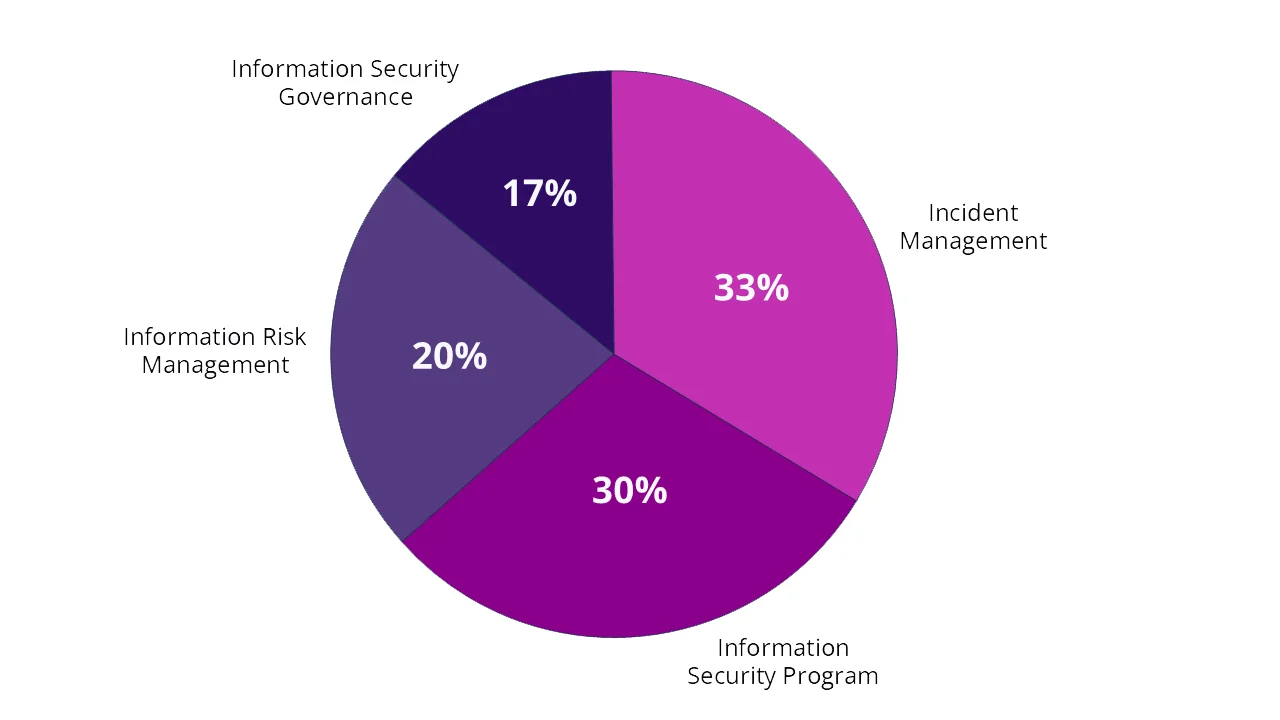
The CISM exam is designed to test judgment and decision-making in real-world management scenarios. It consists of 150 multiple-choice questions, with a time limit of four hours.
The exam is structured around four core domains:
1. Information Security Governance
This domain focuses on establishing and maintaining a governance framework that aligns security strategy with business objectives. It includes policy development, leadership engagement, and organizational structure.
2. Information Risk Management
This domain addresses how organizations identify, assess, and manage risk. It emphasizes risk appetite, risk treatment strategies, and integration with enterprise risk management.
3. Information Security Program
This domain covers the design and management of a security program, including resource allocation, architecture oversight, and program maturity.
4. Incident Management
This domain focuses on incident response planning, detection, and recovery at a strategic level, ensuring that incidents are handled in alignment with business priorities.
The weighting typically prioritizes governance and risk, reinforcing the certification’s leadership focus.
CISM Eligibility Requirements
Achieving CISM certification requires more than passing the exam. ISACA enforces experience requirements to ensure candidates have real-world exposure.
Candidates must have the following work experience:
- Five years of experience in information security management
- Experience across at least three of the four CISM domains
There are some waivers available for certain certifications or degrees, but at least three years of relevant experience are typically required.
In addition, candidates must:
- Agree to ISACA’s Code of Professional Ethics
- Commit to continuing professional education (CPE) requirements
- Apply for certification within five years of passing the exam
This ensures that CISM holders are not only knowledgeable but also experienced practitioners.
How to Register for the CISM Exam
Registration for the CISM exam is done through ISACA’s official website. The process is straightforward but requires planning.
Candidates need to:
- Create an ISACA account
- Purchase the exam (discounted pricing for members)
- Schedule the exam through the authorized testing provider
The exam is offered via remote proctoring or at physical testing centers, providing flexibility depending on your preference and location.
How to Prepare for CISM
Preparation for CISM is less about memorization and more about understanding how ISACA expects security leaders to think.
Recommended Study Approach
The most effective approach combines conceptual learning with scenario-based thinking. You should focus on understanding why certain decisions are correct from a governance or risk perspective.
Successful candidates typically follow a consistent strategy:
- Learn concepts, not just definitions
- Practice scenario-based questions extensively
- Think from a business and risk perspective
- Avoid purely technical answers unless aligned with business goals
The key shift is moving from “What is technically correct?” to “What is strategically appropriate?”
Exam Mindset
During the exam, the correct answer is often the one that:
- Aligns with governance and policy
- Prioritizes risk-based decision-making
- Reflects business impact
- Follows structured processes
This mindset is critical to passing.
CISM Study Resources
A combination of official and third-party resources provides the best coverage.
Commonly used resources include:
- Online courses (self-paced or instructor-led)
- Practice exams from reputable providers
What to Expect on Exam Day
On exam day, candidates must follow strict identification and testing protocols, especially for remote proctored exams.
The experience is straightforward:
- Identity verification and environment checks
- Four-hour timed exam
- Immediate preliminary results upon completion
If you pass, you will receive instructions on applying for certification.
If you fail, you can retake the exam. ISACA allows multiple attempts, though additional fees apply.
Maintaining Your CISM Certification
Maintaining CISM requires ongoing professional development and adherence to ISACA standards.
Certified professionals must:
- Earn 20 CPE hours annually
- Maintain 120 CPE hours over a three-year cycle
- Pay annual maintenance fees
- Adhere to ISACA’s ethics guidelines
This ensures that certification holders remain current with evolving security practices and leadership expectations.
CISM FAQ
Not necessarily. CISM is less technical and considered less prestigious but might be focused on management thinking and decision-making.
Can I take CISM without experience?
Yes, but you will not be certified until you meet the experience requirements.
How long should I study for CISM?
Typically 4–8 weeks for experienced professionals, longer for others.
Is CISM worth it for technical roles?
It depends. It is most valuable for those moving into leadership or governance roles.
Does CISM expire?
Yes, but you can maintain it by showing ongoing CPEs and paying annual maintenance fees.